How to Maximize the Chase Sapphire Reserve Welcome Bonus
-
 Written by
Sarah Silbert
Written by
Sarah Silbert
-
 Edited by
Jasmin Baron, CCC™
Edited by
Jasmin Baron, CCC™

The Chase Sapphire Reserve® remains one of the best travel rewards cards thanks to its premium travel perks and the points currency, Chase Ultimate Rewards®, which offers real flexibility and value.
Another key reason is its generous welcome bonus. If you meet the minimum spending requirement to earn the offer, you’ll have a nice stash of Chase Ultimate Rewards points to start booking free travel.
But not all options for redeeming Ultimate Rewards points are equal. So if you want to maximize your Chase Sapphire Reserve welcome bonus, keep reading for the best ways to use those points.

400+ Credit Cards
Analyzed independently across 50+ data points in 30+ product categories

Reviewed
By a team of credit card experts with an average of 9+ years of experience

Trusted by
More than one million monthly readers seeking unbiased credit card guidance
CardCritics™ editorial team is dedicated to providing unbiased credit card reviews, advice and comprehensive comparisons. Our team of credit card experts uses rigorous data-driven methodologies to evaluate every card feature, fee structure and rewards program. In most instances, our experts are longtime members or holders of the very programs and cards they review, so they have firsthand experience maximizing them. We maintain complete editorial independence — our ratings and recommendations are never influenced by advertiser relationships or affiliate partnerships. You can learn more about our editorial standards, transparent review process and how we make money to understand how we help you make informed financial decisions.
What Is the Chase Sapphire Reserve Welcome Bonus?
The Chase Sapphire Reserve is currently offering a welcome bonus of 100,000 points after you spend $6,000 on purchases in the first three months from account opening.
The exact welcome bonus has changed over time, though this is one of the highest offers we’ve seen for this card. The basic structure is always the same, though: You’ll earn a certain number of points after meeting a minimum spending requirement. This applies to both the Sapphire Reserve and rewards credit cards in general, though some credit card welcome bonuses may have slightly different timeframes, such as 90 days or five to six months from account opening.
If you apply for the Sapphire Reserve, you’ll want to make sure you can meet the minimum spending requirement. Otherwise, you’re simply leaving too much value on the table. If you don’t typically put $6,000 worth of spending on a credit card in three months, it could be helpful to time your application around major purchases. For example, if you’re planning to book an expensive trip or buy new furniture, charging those purchases to your new card could make it easy to meet the minimum spending requirement.
Why the Chase Sapphire Reserve Bonus Is So Valuable
100,000 Chase points probably sounds like a lot, but let’s get specific about how much value the Sapphire Reserve welcome bonus represents.
How Much Are Chase Ultimate Rewards Points Worth?
According to Chase’s calculations, 100,000 Ultimate Rewards points are worth $2,000 for select flights and hotels booked through Chase Travel℠. This assumes you use all 100,000 points for Chase’s Points Boost redemptions, which, in most cases, get you up to 2x value when you use points directly through the Chase travel portal (a handful of select hotels through The Edit, Chase’s luxury hotel booking platform, now offer up to 2.5x through Points Boost).
But that’s only one way to use your points. An even better option is to move your points to one of Chase’s airline or hotel transfer partners. The advantage here is that there’s technically no cap to how much value you can get from your points, unlike with redemptions through Chase Travel, where you’ll usually max out at 2 cents per point.
Best Ways to Redeem the Welcome Bonus
The best way to use the Chase Sapphire Reserve’s welcome bonus will depend on your travel plans, but you’ll have strong options virtually anywhere you travel.
In general, the highest-value options are:
- Travel bookings through Chase Travel
- Airline transfer partners
- Hotel partners for high-value redemptions
Chase Travel
As mentioned above, Chase Travel redemptions get you a maximum value of 2 cents per point (with a few exceptions). That’s not bad, but you can do better if you’re smart about using Chase’s transfer partners. But there are some situations where the Chase Travel portal is a stronger choice, such as when:
- You’re traveling to a destination that doesn’t have many chain hotels (so you can’t take advantage of Chase’s hotel transfer partners)
- You’re trying to use the Sapphire Reserve’s The Edit credit (up to $250 back on prepaid hotel bookings made through The Edit by Chase Travel twice per year)
Airline Transfer Partners
If you’re simply looking to get the highest value from your Chase points, you’ll want to explore transferring your rewards to a partner airline loyalty program. You can often get significantly more than 2 cents per point in value, especially if you book a premium-cabin award flight.
I actually just did this to book flights to France for an upcoming vacation. I was eying two seats on a flight from New York-JFK to Paris (CDG) in Air France’s business cabin. The cash rate was $2,424, and the award cost was fluctuating wildly.
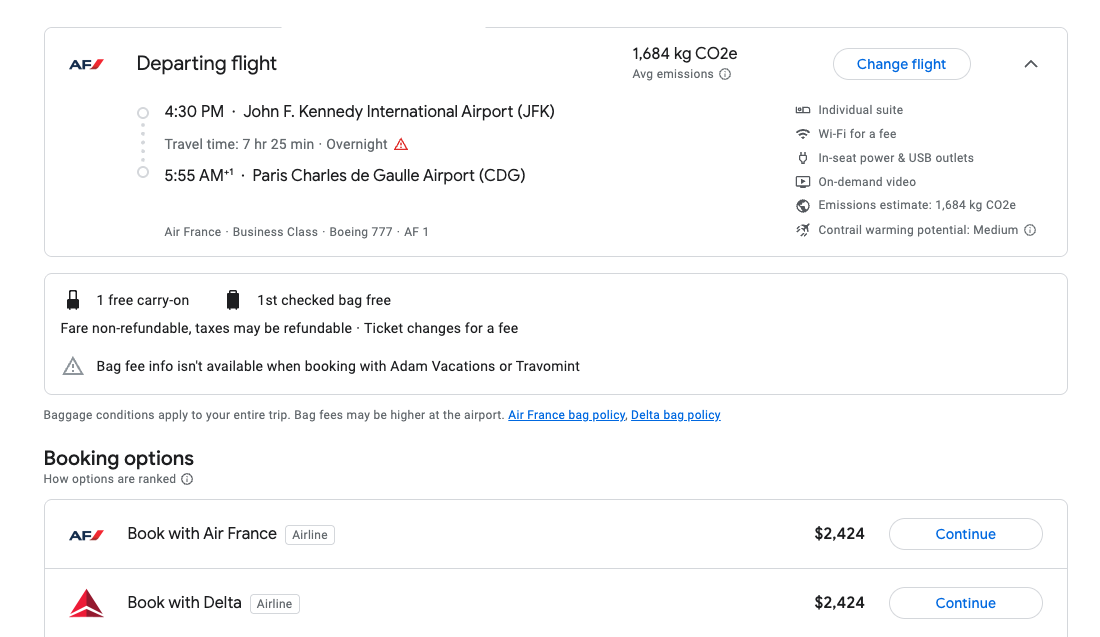
When it dipped to 60,000 Flying Blue miles per seat, I quickly transferred Chase points to Flying Blue, the loyalty program of Air France and KLM. Even with a $245.60-per-ticket surcharge, this booking gave us 3.6 cents per point. And best of all, we’ll be flying across the Atlantic in comfort.
Hotel Transfer Partners
I didn’t just use Chase points for the flight over, either. One of my favorite Chase transfer partners is World of Hyatt, since you can use it to book high-end hotels that cost over $1,000 a night without spending a fortune in points.
I’ve stayed at the Park Hyatt Paris-Vendome before and loved it, so when I saw availability for our travel dates, I immediately moved Chase points to Hyatt to book two nights for 40,000 points each. If I’d paid in cash, each night would have cost $1,648.
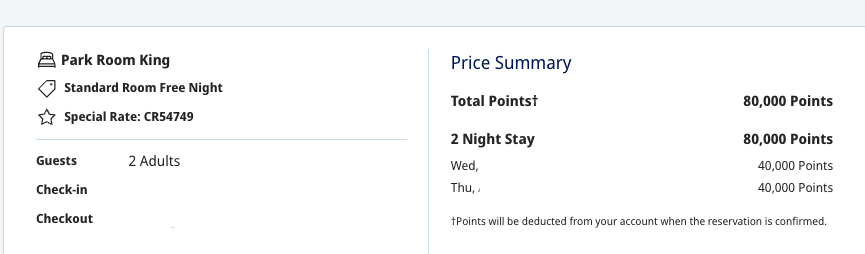
Dividing the cash rate by the number of points, I’m getting an outstanding value of over 4 cents per point for this redemption. That’s twice the maximum value you can get when you redeem Chase points for travel directly through Chase’s portal.
How to Earn the Chase Sapphire Reserve Bonus Quickly
Earning the welcome bonus is key to fully maximizing the Chase Sapphire Reserve, but you shouldn’t spend more than you need to just to meet the minimum spending requirement of $6,000 in the first three months. Here are some tips to close the gap if you don’t normally charge $2,000 or more to your credit card each month.
Smart Spending Strategies
One of the best ways to meet the minimum spend requirement is to time your credit card application to coincide with big purchases. For instance, if you’re planning on booking a family trip, meeting the minimum spending requirement might be much easier, especially if you’re able to put everyone’s expenses on your card and ask them to reimburse you for their portion.
You can apply the same basic strategy for large-group meals: offer to grab the bill and just ask your dining companions to pay you back for their share.
You might also be able to charge business-related expenses to your card and have your company reimburse you, but you should always ask for permission first; don’t just assume that this is allowed.
What Purchases Count Toward the Bonus
To meet the Sapphire Reserve’s minimum spending requirement, make sure you know exactly what counts as an eligible purchase. Any standard purchases should count, but balance transfers, cash advances, and other cash-like transactions, such as wire transfers and money orders, do not.
Boosting the Bonus Value With Chase Sapphire Reserve Benefits
Having 100,000 Chase points is a great place to start, but other Chase Sapphire Reserve benefits can stretch your rewards even further and add more value.
Using the Annual Travel Credit
One of the Sapphire Reserve’s easiest-to-use perks is a $300 annual travel credit that automatically applies to virtually all travel-related expenses. As long as you spend at least $300 on travel each year (and you absolutely should if you’re considering this premium travel card), this benefit effectively cancels out $300 of the card’s $795 annual fee.
The travel credit resets each cardmember year (measured from your account opening date), not the calendar year, so it’s worth using it early. If you apply in March, for example, book travel expenses soon after rather than waiting until December, so you capture the value in case your plans (or the card) change before your next renewal.
Earning and Redeeming Points With Travel and Dining Categories
Once you’ve earned the welcome bonus and start redeeming Chase points, you’ll want to earn more of them so you can start working toward your next award trip. The Sapphire Reserve’s bonus earning categories come in handy here. You’ll earn 3x points on dining worldwide, plus 4x points on flights and hotels booked direct.
The Sapphire Reserve is my go-to card for pretty much any dining purchase, from ordering on DoorDash to dining out. I also use it to pay for almost all travel expenses, thanks to its high earning rates and valuable travel protections, including baggage coverage and trip delay insurance.
Pairing the Chase Sapphire Reserve With Other Chase Cards
Beyond maximizing the Sapphire Reserve’s perks and bonus earning categories, pairing it with another one of the best Chase credit cards is a great way to boost your rewards balance. Best of all, this doesn’t require paying another annual fee.
Sapphire Reserve + Chase Freedom Unlimited
The Chase Freedom Unlimited® is a no-annual-fee cash-back credit card, but if you pair it with a card like the Sapphire Reserve, you can combine your rewards and unlock better redemption options.
Not only can holding the Freedom Unlimited boost your Ultimate Rewards balance, but it’s also a strong option for everyday, non-travel spending. It earns 3% back at drugstores and on dining, and 1.5% cash on all non-bonus purchases. That translates to a minimum of 1.5x Chase points on all spending.
Sapphire Reserve + Chase Freedom Flex
The Chase Freedom Flex® is another no-annual-fee card that pairs well with the Sapphire Reserve since you can combine rewards and increase your earning potential across spending categories.
The Freedom Flex has rotating quarterly bonus categories, and you can earn 5% on up to $1,500 in combined purchases each quarter (then 1%). Amazon purchases are one of the quarterly bonus categories most years, and it’s usually easy for me to max out the $1,500 cap to earn 7,500 Chase points.
Chase Sapphire Reserve Eligibility Rules Explained
Chase 5/24 Rule
Chase has an unpublished 5/24 rule that applies to credit card applications. Basically, if you’ve opened five or more credit cards from any bank in the last 24 months, Chase typically won’t approve you for any of its cards. Some small business cards don’t count toward 5/24, but pretty much all personal credit cards do.
So before you apply for the Sapphire Reserve, make sure you’re “under” 5/24. Otherwise, you’re likely to be denied for the card, and it’s better to wait until enough of your older accounts age past the 24-month mark before applying.
Sapphire Family Bonus Restrictions
Chase limits how often you can earn a welcome bonus on its Sapphire cards. You can only earn the bonus on a given Sapphire card once per lifetime, so if you’ve previously earned the welcome bonus on the Sapphire Reserve, you won’t be eligible for another one, even if you downgraded or closed the card. (This replaced an older rule that allowed a new bonus every 48 months.)
You also can’t hold the Sapphire Reserve and Chase Sapphire Preferred® Card at the same time. If you have one and want the other, you’ll need to product-change or close your existing card before applying, though a product change won’t earn you a new welcome bonus.
Is the Chase Sapphire Reserve Welcome Bonus Worth It?
The Chase Sapphire Reserve is worth it if you can take full advantage of its many perks and, most importantly, if you don’t let its high welcome bonus go to waste. Here’s a closer look at when it makes sense:
When the Bonus Delivers Excellent Value
The welcome bonus is objectively strong, but not all points redemptions are equally valuable. The people who will get the most out of it are:
- Frequent travelers: While you can redeem Chase points for things like Amazon purchases and cash back, they offer the most value for travel redemptions, and it’s not even close.
- Users who redeem points strategically: This means taking advantage of transfer partners to book flights and hotels, usually for fewer points than what you’d pay directly through Chase Travel.
- People who maximize travel credits and perks: You’ll get even more out of the welcome bonus if you also use the card’s annual travel and hotel credits to put as much money back in your wallet as possible.
If you’re still not sure if the card makes sense for you, read our Chase Sapphire Reserve review for a closer look at its lineup of benefits.
When Another Chase Card Might Be Better
On the other hand, the following users will probably do better with another Chase credit card:
- Lower spenders: It’s not worth getting the Sapphire Reserve if you can’t meet the minimum spending requirement for the welcome bonus, and the annual fee won’t be worth it in the long run if you don’t charge enough to the card to take advantage of the annual travel credits and bonus categories.
- Occasional travelers: If you only travel once or twice a year, you might not get enough value out of the card’s points, not to mention its travel-related benefits like hotel credits, IHG One Rewards Platinum Elite status, and a fee credit for Global Entry, TSA PreCheck, or NEXUS.
- Those who prefer simpler reward structures: If you don’t want to keep track of different bonus spending categories, you may prefer a flat-rate rewards card that earns the same amount of points or cash back on every purchase.
If you like the idea of a travel card that earns transferable Chase Ultimate Rewards points but prefer a lower annual fee, consider the card’s sibling, the Chase Sapphire Preferred Card. At $95 a year, it’s much more affordable, offers the same transfer partners, and includes benefits such as an annual Chase Travel hotel credit of up to $100 and strong travel insurance.
The information related to the Chase Sapphire Reserve® was collected by CardCritics™ and has not been reviewed or provided by the issuer of this product/card. Product details may vary. Please see issuer website for current information. CardCritics™ does not receive a commission for this product.
Frequently Asked Questions About the Chase Sapphire Reserve Welcome Bonus
What is the Chase Sapphire Reserve 100,000-point offer?
The Chase Sapphire Reserve is currently offering a welcome bonus of 100,000 Ultimate Rewards points after you spend $6,000 on purchases in the first three months from account opening.
How much are 100,000 Chase points worth?
100,000 Chase points can be worth as much as $2,000 if you redeem them for flights and hotels through Chase Travel. They could potentially be worth even more if you transfer them to Chase’s airline and hotel loyalty program partners to book flights or free nights.
Is the Chase Sapphire Reserve welcome bonus worth it?
The Chase Sapphire Reserve’s welcome bonus can definitely be worth it if you plan to travel in the future, because there are many high-value options for redeeming your points for flights, hotels and more.
What is the highest-ever Chase Sapphire Reserve bonus?
The highest-ever welcome bonus on the Chase Sapphire Reserve is for 150,000 points after meeting minimum spending requirements.