Transfer Partners vs. Travel Portals: Which Redemption Strategy Offers More Value?
-
 Written by
Gabriel Vito
Written by
Gabriel Vito
-
 Edited by
Emily Gadd, CCC™
Edited by
Emily Gadd, CCC™
-
 Reviewed by
Jasmin Baron, CCC™
Reviewed by
Jasmin Baron, CCC™

Both travel portals and transfer partners let you redeem credit card rewards for travel, but they don’t offer the same value. Many of the best travel credit cards allow you to redeem rewards through either method, and choosing the right one can mean the difference between an average redemption and a luxury trip for the same number of points.

400+ Credit Cards
Analyzed independently across 50+ data points in 30+ product categories

Reviewed
By a team of credit card experts with an average of 9+ years of experience

Trusted by
More than one million monthly readers seeking unbiased credit card guidance
CardCritics™ editorial team is dedicated to providing unbiased credit card reviews, advice and comprehensive comparisons. Our team of credit card experts uses rigorous data-driven methodologies to evaluate every card feature, fee structure and rewards program. In most instances, our experts are longtime members or holders of the very programs and cards they review, so they have firsthand experience maximizing them. We maintain complete editorial independence — our ratings and recommendations are never influenced by advertiser relationships or affiliate partnerships. You can learn more about our editorial standards, transparent review process and how we make money to understand how we help you make informed financial decisions.
What Is the Difference Between Transfer Partners and Travel Portals?
What Are Transfer Partners?
Transfer partners are airline frequent flyer programs and hotel loyalty programs that work with your credit card’s rewards system. These partnerships allow you to transfer your earned credit card points to airline or hotel programs and redeem them for travel.
Many issuer programs, such as Chase Ultimate Rewards®, American Express Membership Rewards®, Citi ThankYou® Rewards and Capital One Rewards, have a set list of transfer partners that cardholders can choose from when redeeming points.
Savvy travelers often use transfer partners because airline and hotel loyalty programs can sometimes offer better value per point. In short, transferring points to a partner program can help you stretch your rewards further and potentially require fewer points for the same trip.
What Are Travel Portals?
Travel portals are booking and search platforms provided by credit card issuers. Searching for flights, hotels and rental cars through a portal works much like third-party online travel agencies like Expedia, because you simply enter your travel dates and compare options. The difference is that you can apply your credit card rewards points toward the cost of the booking, and you can often earn extra rewards points when booking with a credit card through your card issuer’s travel portal.
The main advantage of travel portals is simplicity. Points are applied toward the trip cost at a fixed rate, making it easy to see exactly how many points are needed.
How Transfer Partners Work
The key to getting more value from your points is learning how to research your card issuer’s transfer partners.
Transferring Points To Airline Loyalty Programs
Many travel credit cards let you transfer rewards points directly to airline loyalty programs, often at a 1:1 ratio. But that ratio isn’t where the value is. The real value comes from the fact that each airline loyalty program prices award tickets differently. The same itinerary can require very different mileage depending on which program you book through.
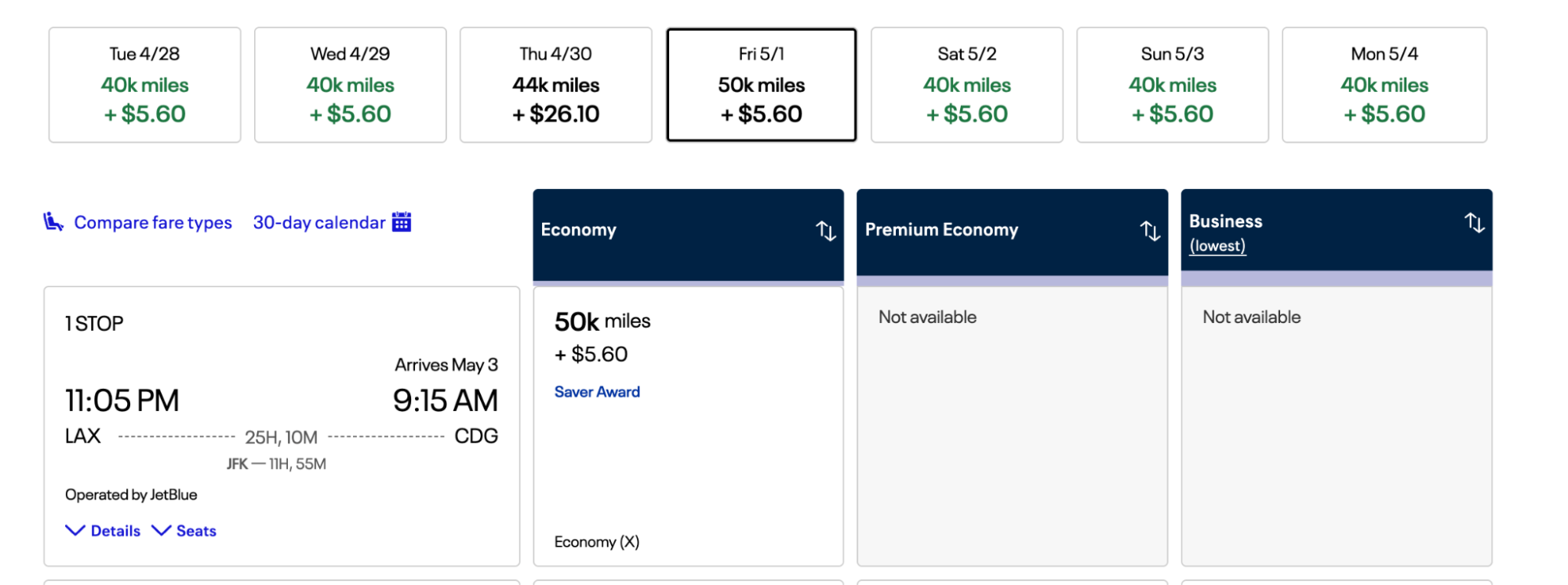
For example, consider a one-stop economy flight from Los Angeles (LAX) to Paris (CDG). Booked through United MileagePlus, this ticket costs 50,000 miles plus about $6 in taxes.
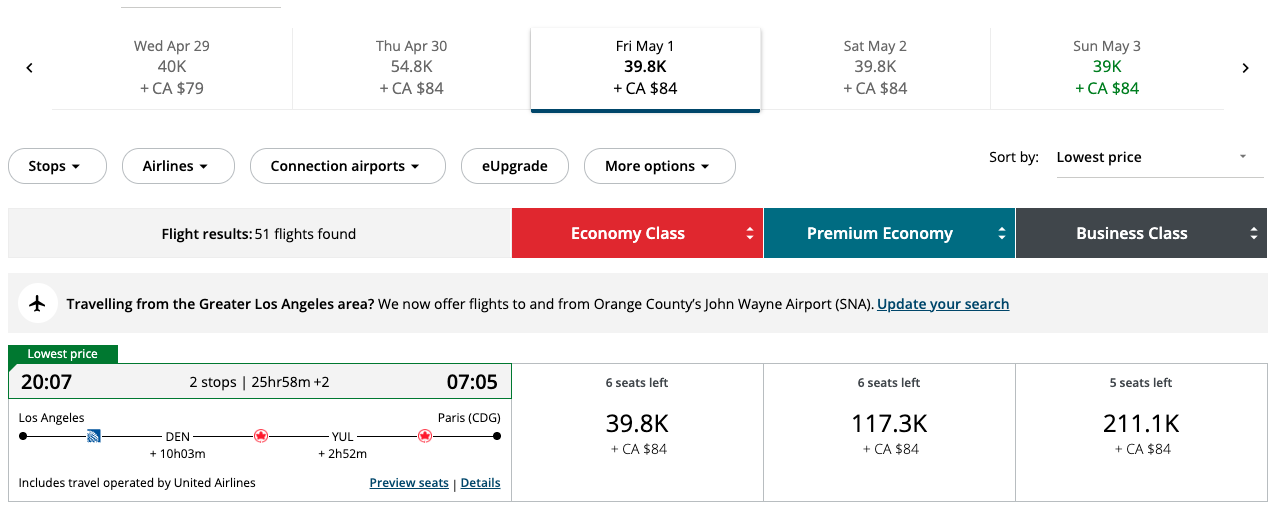
Search the same route through Aeroplan, Air Canada’s loyalty program, and the price may drop to around 39,800 points, though the taxes and fees increase to 84 Canadian dollars (about $60). Even with higher fees, the Aeroplan option comes out ahead.
Also, because airlines operate within global alliances, their miles can be used to book flights on partner carriers worldwide. For example, you can use Aeroplan points to book Lufthansa flights, because both airlines are part of the Star Alliance. Similarly, Air France-KLM Flying Blue miles can be used to book Delta flights, because those airlines are part of the SkyTeam alliance.
In my experience, finding the best transfer partner for a specific route takes research and patience. When I was pricing flights to Amsterdam last year, I compared award rates across Aer Lingus, Aeroplan and Flying Blue before settling on the best deal.
Some card issuers occasionally offer transfer bonuses, which can temporarily increase how many miles or points you receive when transferring.
One rule, regardless of which program you choose, is that transfers are permanent. Always confirm award availability before initiating a transfer.
Transferring Points To Hotel Loyalty Programs
Many travel credit cards also allow points to be transferred to hotel loyalty programs like World of Hyatt, Marriott Bonvoy, Hilton Honors and Choice Privileges. As with airline transfers, these transfers are permanent.
The key question with hotel transfers is whether redeeming points is better than paying cash. For premium properties, the math often works out strongly in your favor.
Take the Park Hyatt Zurich. A room with two twin beds runs $1,006 per night at the Hyatt member rate.

Book the same room through World of Hyatt using Chase Ultimate Rewards points transferred at a 1:1 ratio, and that same night costs 45,000 points. That works out to roughly 2.2 cents per point in value, more than double what a travel portal typically offers.

Pros and Cons of Using Transfer Partners
Pros
- Can deliver significantly more value per point, especially for international routes, premium cabins and luxury hotel stays
- Airline alliances mean one loyalty program can book flights on dozens of carriers worldwide
- Card issuers occasionally offer transfer bonuses, temporarily increasing how many miles or points you receive
Cons
- Not all hotel transfer partners offer good value, as some programs have unfavorable conversion ratios, meaning you receive fewer points than you transferred
- Award availability can be limited and may not align with your preferred dates or route
- Transfer times can vary, and award availability may disappear while you’re waiting for your transfer to complete
- Transfers are permanent and cannot be reversed, so always confirm availability before moving points
How Travel Portals Work
The main benefit of travel portals is their ease of use.
Booking Flights, Hotels and Rental Cars Through a Portal
Travel portals work like a regular online travel booking site. You search for a flight, hotel or rental car, and the portal shows you both the cash price and the points required to cover it. You can pay entirely in points, entirely in cash or a combination of both, depending on your card.
The main advantage is simplicity. There are no award charts to decode, no loyalty program accounts to create and no availability to hunt across multiple airlines or hotel chains. If a flight or award night exists, you can book it with points in minutes.
Fixed-Value Redemptions Explained
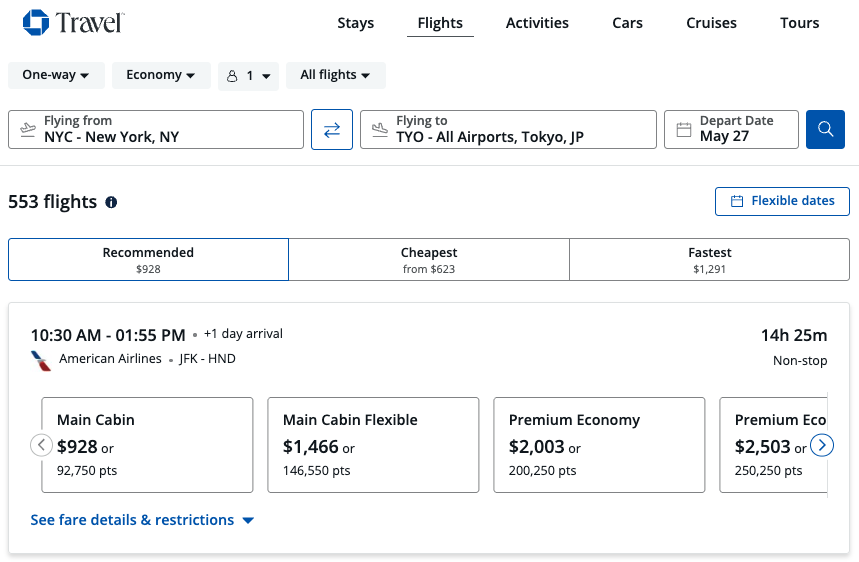
The tradeoff for that simplicity is a fixed redemption rate. For example, this one-way economy flight from New York (JFK) to Tokyo (HND) booked through Chase Travel℠ costs $928 or 92,750 points, for a straightforward fixed-value redemption at 1 cent per point.
Many portals value points at 1 cent each, so a $250 flight costs 25,000 points regardless of which card you’re using. Some premium cards offer slightly better rates. Chase Sapphire Reserve® cardholders, for example, get up to 2 cents per point through Chase Travel’s Points Boost feature, but only on certain redemptions. Still, the value is fairly predictable and capped, compared to transferring your points to an issuer’s partner.
Some cards also reward you for using their portal, but only on the portion of the booking you pay for with your card. For example, the Capital One Venture X Rewards Credit Card earns 5x miles on flights and vacation rentals and 10x miles on hotels and rental cars booked through Capital One Travel. Those multipliers can add up fast.
I still use the travel portal when I don’t have enough points to meet a transfer partner’s minimum or when I’m holding out for a higher-value redemption. With the Chase Sapphire Preferred® Card, I earn 5x points on travel booked through Chase Travel.
Pros and Cons of Using Travel Portals
Pros
- Simple to use because any bookable flight can be paid with points without needing to research reward programs
- Booking through the portal earns airline miles and elite status credits on most flights
- Option to combine points and cash when points don’t cover the full cost
- No blackout dates or award availability issues to contend with
Cons
- Fixed redemption rates cap your value at 1 to 2 cents per point
- Points requirements are tied to cash prices, meaning peak season flights cost more points, with no way to offset the difference
- Hotel nights booked through portals typically don’t earn hotel points or elite status credits, and you may not have your elite status (if any) recognized during your stay
- Most bookings route through third-party customer service if issues arise
Bottom Line
Transfer partners take more work, but if you’re willing to compare programs and stay flexible on dates, you’ll usually get more value out of your points. Unlike portal pricing, which rises and falls with the cash fare, transfer partner programs price award flights on their own terms. A business-class seat may cost the same number of miles whether the ticket is $3,000 or $5,000.
If you need to book fast or your points balance isn’t quite there yet, the portal gets the job done with little effort, but the tradeoff is that your points may not go as far.
The strategy is knowing how to use each tool and when. Always compare the number of points you’ll need to transfer to an airline or hotel program to book an award flight or stay versus using points to cover the cost at a fixed rate through a travel portal.
The information related to the Chase Sapphire Reserve® was collected by CardCritics™ and has not been reviewed or provided by the issuer of this product/card. Product details may vary. Please see issuer website for current information. CardCritics™ does not receive a commission for this product
Frequently Asked Questions About Transfer Partners vs Travel Portals
Is it better to transfer credit card points to airlines?
It depends on the value you’re trying to get from your points. Transferring to airline partners can sometimes require fewer points for the same flight, especially on international routes or premium cabins. If you don’t have enough points for a transfer redemption or want a simpler booking process, using a credit card travel portal may make more sense.
Can you use points and cash together in a travel portal?
Often yes. Many credit card travel portals allow you to combine points and cash if you don’t have enough points to cover the full cost of the trip.
Can you transfer credit card points back after transferring them?
Point transfers are usually permanent, so once you move credit card points to an airline or hotel loyalty program, they can’t be transferred back.
When should you use a travel portal instead of transferring points?
A travel portal can make more sense when you have fixed travel dates, want a simpler booking process or when airline award seats or hotel award nights aren’t available.
Do travel portals always give less value than transfer partners?
Travel portals do not always provide less value, since cheaper flights or limited award availability can sometimes make portal redemptions the better option.